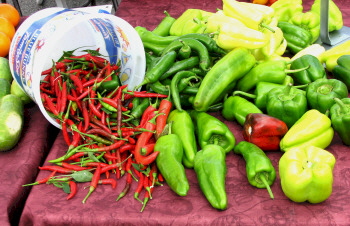
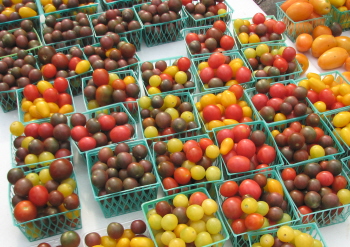
What do you do when someone gives you nearly a peck of (unpickled) hot peppers like these? If you’re like me, you freeze them. (Of course, you could also pickle them.)
I no doubt harmed their quality by letting them sit in the fridge for a week, but then I dug in. I washed them, lopped off their tops, split them lengthwise and removed membranes and seeds with a quick flip of a paring knife. Then I filled two quart-size freezer bags with them and put them in the freezer. That was it.
Unlike most fruits and vegetables, you can freeze peppers—hot peppers or sweet (bell) peppers—without blanching. The University of Nebraska extension office says you don’t even need to cut your hot peppers. I did, though, because I wasn’t sure how hot these peppers might be. (They seemed too small for banana peppers, and I’m not sufficiently pepper-savvy to identify the type, but the friend who gave them to me said they were superhot. I finally tasted one about halfway through my exercise, and they weren’t all that hot.) No matter, they’re ready to go into soups, casseroles or wherever I want them. I can leave them halved or chop them later.
TIP: Don’t forget either to use fork and knife to hold and cut your hot peppers or to wear rubber gloves while you work unless you’re exceedingly tough like my brother-in-law. Hot pepper juice does burn—especially if you make the highly unfortunate mistake of getting it in any tender areas such as your eyes or nose.
The common wisdom is that the fruit trees in this region are making up this year for last year’s noncrop. Apple trees are no exception, sending out vast amounts of fruit, just as the pear trees and cherry trees and raspberry brambles did this year.
Sample apples
My first 2008 apples, as you may recall, were the summer Lodi apples. So far this fall, I’ve only received three free apples, as seen in the photo above, and they are humdingers. See that quarter there for size? And each apple weighs/weighed more than 8 ounces. My oldest sister gave them to me the other day, samples from her haul from Waverly, Missouri (something of a centroid of apple production in the area for one reason or another, including at Peters Orchard).
She gave me a sample of each of the three varieties she bought. From left, in the photo above, are Jonagold, Jonathan and Fuji. Only the Jonagold remains, and not for long. I’m quite sure I’ve never seen a Jonathan as big as this one was, but it’s flavor (sweet-tart) and texture were delicious. The Fuji was quite sweet. Both have, as expected, fairly thin skins.
Local apples
Meanwhile, I’ve been buying local apples, too. I bought Gala and Golden Delicious from a vendor at the Lawrence Farmers Market who was in from Sabetha, Kansas. (Or was it Seneca. Drat. Guess I’ll have to figure that out later.) I haven’t gotten into the Goldens yet, although the vendor said they were pretty tart, and they’re a little on the green side. I don’t doubt him; Golden Delicious are wonderful for baking (and not related to Red Delicious I learned recently), but the local ones never seem to capture the sweetness that the Washington ones do. The Galas were agreeably sweet and crisp.
I also bought Jonathans from Fieldstone Orchard of Overbrook, Kansas, at the Community Mercantile. Ken Krause, who chatted up Merc customers last Saturday on a vendors day, said the family also has a you-pick operation, which got a nice writeup in Fat City. And I got those 50-cent-a-pound Jonathans (scroll down for the apple reference on that link) at Davenport. I should have gotten more; they’re almost gone.
On top of all those apples are the three or four Red Delicious last week in my Rolling Prairie bag. Haven’t tried them yet. Red Delicious aren’t my favorite. Don’t care for the leathery skin or the supersweet (or tasteless) flavor and the often-mealy texture. But. I’m sure these are dandy, and they probably are the only organic ones in the lot.
How ’bout them apples?
The Jonathan and Golden Delicious are probably my favorites for their lovely but different flavors and their versatility for eating and baking. What are your favorites? Why?
Amazingly, for all these apples, I have yet to bake apple anything. I’ve just eaten them daily, sometimes two or three of them. Like the trees, I’m trying to make up for last year’s noncrop.
They came. They tasted. They were surprised and pleased. That’s the nutshell result of a group of friends’ tasting local wines. Kansas wines. Mostly Douglas County wines. (Kansas licenses several more wineries, too.)
To recap, here are the wines we tasted and the order we tasted them in:
Seyval. Holy-Field. $12.95. (In photo at right, which is in focus, but it’s chilled and instantly collects condensation.) Also, a Seyval from Kugler’s, which a couple of our tasters brought, as Kugler’s is their neighbor.
Corky’s Barrel. Holy-Field. A red blend of Chambourcin, Cynthiana (a.k.a. Norton) and Foch, $10.95. Someone over the phone identified the grapes for me, and I swear she said it was spelled Fouche. I was unable to find any information about a Fouche grape, so I’ve concluded it must in fact be Marechal Foch, a.k.a. simply Foch.
Wolf Red. BlueJacket Crossing. An off-dry red made from Chambourcin and St. Vincent grapes and aged in American oak.$11.00.
If I had it to do over, I’d have started with the Vignoles rather than the Seyval, but we didn’t. No matter. The Holy-Field Seyval was greeted with “I love it!” and “Oh! This is good!” and then Brian pronounced that it “compares favorably with some very expensive California Rieslings.” I wouldn’t know, but it was, as the vineyard’s flier declared, a fine wine, delicate and crisp with loads of apple character. It had as much complexity and body as any white wine I can think of.
Then we had the Kugler Seyval. It had some of the same flavors but was overlain by excessive sweetness and didn’t match up.
Next, we went to the Vignoles, a sweet (or maybe off-dry) white with distinct grapefruit and other citrusy flavors. It’s good. It is, however, distinctly lighter than the Seyval and suffered a bit from the comparison, which is why I wish we’d served it first.
The reds
Since we weren’t able to get any dry wines, our reds were off-dry to sweet. We started with Corky’s Barrel, which again was quite satisfying, with a medium body and layered flavors. The Wolf Red (at left) had a similar character but more sweetness.
The meal
After tasting those wines, we adjourned to dinner, where we feasted on local chicken (both as chicken salad and chicken Marbella), local beef brisket (fully pastured, on the guests’ own property), a salad featuring local kale and roasted peppers. We also had local cucumbers, peppers and a little bit of melon to snack on.
I guess it’s an indication that summer’s peak has passed, as no one brought the tomatoes or beans I might have expected. Nevertheless, it was all delicious. The two Holy-Field wines were the most popular choices to go with dinner.
The finishing flavors
We saved the Charlemagne to serve with dessert. It was medium- to full-bodied and sweet, and it complemented the Balsamic-Goat Cheese Pears quite nicely.
Local wines where you live
The biggest drawback to these wines is that they aren’t generally available at your neighborhood liquor store. The proprietor at mine said that’s because the Kansas wineries generally don’t produce enough to interest wholesalers, and wholesalers are where most retailers get their stock. I know I have seen Kansas wines in stores from time to time, but not consistently. Maybe I’ll look into that more at a future date.
Meanwhile, although its information may not be entirely up to date, the Appellation America web site’s appellation index lets you click on your state and see the appellations available there. Yes, there is wine-making in North Dakota. Utah, West Virginia and Vermont, too. Check out your state. Do you drink local wines?
Growing in Kansas. Commentator John Schlageck gives the rundown on Kansas’ ag statistics. (Pittsburg Sun)
Food and fuel. The Agricultural Business Council of Kansas City is having a food and fuel forum on Oct. 23 (DomesticFuel.com)
Food and research. The KC Star endorses a Johnson County, Kansas, sales tax to fund research that would include a K-State facility on food safety and animal health. (KC Star)
Wheat beat. Kansas wheat organizations ask State Fair go-ers about their wheat knowledge. (KansasWheat.com)
In anticipation, perhaps, of today’s autumnal equinox, I went out yesterday and harvested herbs for drying. Based on my success with mint, I decided to cut and dry sage, rosemary (which had developed a couple of flowers), oregano and a teensy bit of thyme. I also decided to wait until I’m ready to bring in the bay laurel before I give it a trim.
Following the usual suggestions, I cut in the morning, and in short order my fingers were sticky with rosemary resin.
From left, sage, thyme (top), oregano, rosemary
I washed the herbs, spun them in my salad spinner, rolled them in a towel and then set them in a breezy, shady spot outdoors in hopes of drying all surface moisture before hanging them to dry in a dark closet. I chose a different location for hanging this time due to the change in the season’s light. (Meaning: I now have to keep my window shades open at night in hopes that a little of the dim early morning sun will filter in and help wake me. Since that works only a little bit, I’m afraid I’d forget to close them during the day and thus leave the herbs in the sun.)
I’ll let you know how these come out. I’m a little worried about the possibility of mold, given the thickness of the sage leaves and the density of the rosemary. Also, this new hanging spot is less airy than my bedroom. If anyone has any tips, let me know!
Lucky me. I found myself in possession of a selection of succulent local pears. Even though these are quite lovely eaten raw, I decided to use nearly all of them as the basis for my local-food contribution to yesterday’s local wine-local food dinner.
At first, I thought I’d make a pear tart of some kind, perhaps a pear tart tatin. Then I looked through a few cookbooks and discovered an unusual and simple recipe for Balsamic-Roasted Pears with Pepper and Honey in my Gourmet Cookbook. I made a few adjustments to suit my needs, and in return I got a delicious, time-saving recipe that was a little different and, despite my fears, not overly sweet. Here’s my version (with a shorter name). It probably isn’t as pretty as Gourmet’s, but it tasted lovely.
Balsamic–Goat Cheese Pears
6 tablespoons butter
6 firm-ripe local pears, peeled, cored and quartered
1/2 cup balsamic vinegar
5 ounces fresh local goat cheese, at room temperature (I used Goatsbeard Farm)
2/3 cup local honey
Freshly ground black pepper
Place butter in 9 x 13 (or so) baking dish, and melt 3-4 minutes in middle of oven as it preheats to 400 degrees.
Arrange pears in single layer in butter. Bake in middle of 400-degree oven until tender, about 15 minutes.
Pour vinegar over pears and bake 5 minutes more. Remove from oven and allow to cool slightly.
Transfer pears to platter. Dot with portions of with cheese, and spoon some of juices from baking dish over pears. Drizzle honey over all, and sprinkle with pepper. Serve warm or at room temperature. Makes 10-12 servings.
In pictures
From left (above): Peeled, cored pear half; raw pears in butter; pears fresh from oven; (below) pears dotted with cheese. Click any for larger view.
Tip: Use a serving dish with a significant lip, or add a lot less pan juices than I did. Despite what I thought were reasonable precautions, I managed to get sticky vinegar-honey-butter stuff all over my car. At least it smells good.