August 13th, 2008 · recipes
And today we present the promised recipe with chicken thighs (and no backbone). It’s based on the Coriander and Mustard Seed Chicken recipe in Gourmet magazine, which I got in a very slightly modified version in the Gourmet Cookbook
. Here’s my version:

Coriander and mustard seed chicken thighs
- 4 chicken thighs
- Salt and freshly ground pepper
- 1 tablespoon olive oil
- 1 shallot, chopped
- 1 1/2 teaspoons mustard seed
- 1/2 teaspoon coriander seed
- 2 tablespoons dry white vermouth
- 2 tablespoons water
- 1 scant teaspoon gooseberry preserves
- Sprinkle thighs with salt and pepper. Heat oil in heavy skillet over medium-high heat until hot. Add thighs, skin side down. Cook until well browned, about 4 minutes. Turn, and brown 3-4 minutes more. Transfer to plate.
- Add shallots to pan and reduce heat to medium. Cook and stir 2 minutes. Add mustard seed, coriander seed, vermouth and water. Add chicken, skin side up.
- Cover pan. Reduce heat and simmer until cooked through, about 20 minutes. Transfer chicken to fresh plate. Add preserves to pan, and stir until melted. Spoon over chicken and serve. Makes 2 servings.
Notes: The original recipe called for red currant or apple jelly, saying “its tart sweetness balances the other flavors.” I didn’t have those, so I used what I did have, which probably was tarter than any apple jelly, and it was very good. The original also called for chopped fresh cilantro in the sauce. I’m sure that would have been good, too, and pretty, but I’d have to conclude it isn’t necessary.

The dish was quite quick and tasty, and the seeds added a pleasant crunch. I served mine with local corn on the cob and sliced tomatoes for a lovely summer meal.
Tags:chicken

Attention chicken cutters: The thigh bone is connected to the knee bone (sort of) and the pelvis bone, but it is not connected to the backbone. That means, if you’re selling me chicken thighs, it shouldn’t have ribs or vertebrae. Those are part of the back, OK?
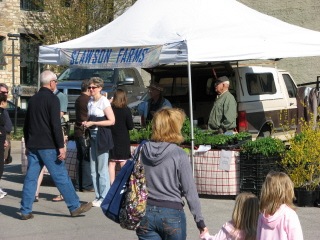
This pressing issue came to my attention most recently when I decided to buy chicken thighs at the Lawrence Farmers Market. Usually, I buy whole chickens, but I thought it would be convenient and different to buy thighs because I don’t cut up raw chickens. I’m not good at it, and I prefer not to get that personal with a chicken before it’s cooked. Besides, I could get a package of pastured chicken thighs for just $3.00 a pound. Zowie! Or so I thought.
Then came cooking time. I open the now-thawed thighs, and the first thing I see when I pick one up is a spine. I repeat: Thighs don’t have backbones.
Furthermore, because I had come across such an odd thigh in the past, I knew that I don’t like to eat thighs with spines. It’s too much work. I am more than happy to labor in the kitchen before a meal, but when I sit down to eat, I want to enjoy the food not work on it. That’s one of the reasons I don’t get excited about chicken wings, artichokes and anything else that results in a pile of leavings that’s larger than the quantity consumed. (I reserve the right to adore some such things; I just can’t think of any at the moment.)
So, in this case, I snarled and separated thigh from extraneous parts before cooking, which revealed that I in fact had spent $6 a pound for pastured chicken thighs and got a bunch of extraneous stuff for free. For a moment, it almost made me long for the time when I could buy a package of industrial chicken thighs whose weight was “enhanced” merely with a vast flap of skin and chunk of chicken fat.
In the end, it all worked out, I suppose. I made my chicken-thigh dish (yum; tune in tomorrow) and threw the free stuff in a pot with water, onions, carrots, salt, pepper and herbs and made broth. And through a little online research, I’ve discovered the question to ask next time I think about buying chicken thighs: oyster cut, or with backbone? (Oyster cut? It’s a bird, for pete’s sake!)
If you want to know what to call your chicken parts, check out the hilarious (to my mind, anyway) pictures at the Rectory Foods site, one pale chicken part per white plate. They even have “chicken paws, skin and nails on.” Maybe it’s a British thing.
Diagram source: Penn State U.
Tags:chicken
I remember reading an interview with Ruth Reichl in which she expressed shock that people changed recipes that they got from Gourmet
magazine, seeing as Gourmet personnel had tested and revised their recipes until they were the best they could be.
I was shocked that she was shocked. (And Ruth, if it wasn’t you, I apologize.) I’m not opposed to following recipes to the letter, but I and most cooks I know look upon recipes as guidelines, not laws. There are several reasons for this:
- Not everyone’s taste is the same. Duh.
- Not everyone has the same ingredients available.
- Some people like to make adjustments for the fun of it.
Marcella and me
Case in point. I recently found myself with a bunch of summer squash and some flat Italian green beans that needed cooking. I was delighted to find that Marcella Hazan, whose cookbook Marcella Cucina I had recently acquired from my father’s estate, adores zucchini and has many recipes for it. Thus I settled on Zucchini, Green Beans, Bell Pepper and Basil. I proceeded to reduce the quantities, alter the method, change an ingredient and serve it not as a side dish but mixed with pasta. It was delicious!
Two versions of ZGBBPB
- 2 small yellow summer squash (hers: 1 pound young, small zucchini)
- 1/2 pound flat green beans (hers: 1 1/2 pounds green beans)
- 1 large mildly hot green pepper of unknown variety; it was about 6 inches long, the width and color of a green bell pepper but it came to a point at the bottom and had about the same heat as an Anaheim (hers: 1 meaty large yellow bell pepper)
- 1/3 pound fresh ripe firm tomatoes (hers: 1/2 pound of same or 1 cup canned imported plum tomatoes)
- 2 tablespoons olive oil, approximately (hers: 1/4 cup of same)
- 1 medium clove garlic, minced, probably about 2 teaspoons’ worth (hers: 1 tablespoon chopped)
- Salt (we agreed)
- Black pepper ground fresh (we agreed)
- A few basil leaves, snipped into strips (hers: 20 leaves, shredded fine with chopping knife. Who counts leaves?)
Her method
I won’t give you all her method details. Too much typing. Let’s just say I didn’t worry much about soaking the squash for 20 minutes before washing it. I didn’t soak the beans, either. After trying for 30 seconds to peel a tomato with a vegetable peeler per her suggestion, I said, “you’ve got to be kidding” and carried on.
My method
Anyway, my method follows. You’ll note that these steps aren’t in the order of the ingredients. That’s because Signora Hazan used four steps to describe the vegetable prep and then in step 5 started the cooking with the fifth and sixth ingredients. I’d rather see the prep included in the ingredients list, because I prep as I cook. You won’t find me resting while the first vegetables sizzle. I’ll be madly chopping the next ones to have them ready in time. Personal preference, I suppose, or an indication I try to do too much in too little time.
- Snap ends off beans and break into 2- or 3-inch pieces. (Her: Keep ‘em whole.)
- Heat oil and garlic in 12-inch pan over medium heat and cook until slightly soft. (Her: Cook till “pale, pale gold.”) Add beans, sprinkle with salt. Reduce heat to low. Cover, and cook 5 minutes.
- Peel the pepper with a vegetable peeler. (Her idea, I did it, and it worked pretty well.) Remove seeds and pith, and cut into 1/2-inch strips. Cut strips into 2-inch lengths. (Her: Leave strips whole.) Add to the beans. Cook 5 more minutes.
- Cut squash julienne. Seed and dice tomatoes. Add to pan with several grindings of pepper. Stir and turn ingredients to coat with oil and seasons. Cook uncovered at low simmer, stirring occasionally, 15-20 minutes. Her: “Taste for doneness—the beans should be firm but tender, and the pepper and some of the zucchini will have partly dissolved. Taste and correct for salt.” OK. No dissolving occurred in my pan, but I don’t care.

- Her: “Off heat, swirl in the shredded basil and serve.” Me: Toss with hot cooked pasta (about 8 ounces dry). Sprinkle with basil and freshly grated Parmesan. Serve. Makes about 4 servings.

Net results
As I said, it was delicious, and I loved the zing the hot pepper gave. I combined the vegetables with spaghetti, because that’s what I had, although I think the eating would be better with penne or some other medium pasta, proof that I don’t even follow my directions if the ingredients require adapting.
I don’t know whether Marcella would approve of my ZGBBPB or not, but it worked with the ingredients I had, and I wouldn’t have thought of doing these ingredients this way without her. I’ll probably make it again, too. More or less.
Tags:green beans·recipes·squash·summer produce
It’s been a great week for news about local and sustainable food. Hooray for summer!
It’s farmers market week. Really, every week is farmers market week around here, April to November (give or take), but markets get a national nod this week. Rah! (K-State news)
Blue-ribbon recipes. Try the prize-winning baking from the Douglas County Fair. (LJ World)
Future growers. Johnson County Community College will begin offering a certificate program in “sustainable agriculture entrepreneurship.” One of the teachers will be sociologist Stu Shafer (named misspelled on JCCC site), a grower with my CSA, the Rolling Prairie Farmers Alliance. The college will coordinate with K-State’s center in Olathe. (JCCC)
Something to squeal about. Big-name chefs see heritage pigs live and die in Missouri, and it’s all in (for?) good taste. (KC Star)
Lawrence growers online. I just became aware of the Lawrence Area Horticultural Producers Association’s website, which extension agent Jennifer Smith says went up last year. You can find local growers there. (GrowingLawrence.org)
Local food gets local feature. Lawrence newspaper highlights Lawrence’s local food. (LJ World.)
No coffee in Kansas. Reporter starts 100-mile diet. (LJ World)
Bringing in the sheaves. Harvesters food pantry gets unusual bread donation. (KC Star)
Time to stock up. The Star’s Cindy Hoedel looks at CSAs and food preservation. (KC Star)
Tags:Farmers markets·local food
Good news! More people are eating home-cooked meals. Bad news! It isn’t what I’d call cooking. Good news! It’s a start, and it could maybe get people thinking about real cooking again. At least I hope so.
The food-spending update
Several reports from the last few weeks suggest more people are eating at home, largely due to budgets pinched by rising prices for food, fuel and everything else:
- The restaurant industry reported sales down in June. CNN presented a related report. (The Sacramento Bee , though, suggested that people were merely trading down to cheaper restaurants. Oy.)
- The New York Times, meanwhile, reported on sales being up at Kraft as a result of pinched wallets.
- Farmers markets are booming, although I haven’t been able to find a link just yet. (Feel free to suggest one!)
The eating opportunity
As previously noted, there’s some evidence that serving processed food at home (hello, Kraft) isn’t really a time saver, despite apparent attitudes to the contrary, and that eating whole foods is healthier for you. I think this trend away from restaurants creates an opening for home-cooking advocates like me.
From time to time I think about creating a website or writing a book to teach noncooks how to cook. I’d like to see common perceptions of cooking move from its being either a chore or entertainment conducted by chefs and TV personalities. I’d love to do something to make cooking accessible. I realize there are folks who might let themselves starve before they’d cook their own food, and they’re probably a lost cause. But there are lots of other people who might cook if they had a clue. What do you think?
Tags:home cooking·processed food
August 5th, 2008 · Books
What fun! When I read Jill Santopietro’s “The Cookbook Chronicles” in the NYT blog The Moment, I knew I had to check my books. My top three:
Mastering the Art of French Cooking
- Joy of Cooking (although mine’s from 1975, so it doesn’t quite make the cut)
- Recipes Worth Sharing, now out of print. It’s a collection I wrote of recipes from the column I did for years at the Kansas City Star. Mentioning it isn’t a shameless plug, because, as I said, it’s out of print. You can find copies at Amazon, and the Star’s store seems to have some copies left.
Meanwhile, the Silver Palate Cookbook also would have been on my list, except my daughter gave me the brand-spanking new edition for Christmas.

How about you? What are your most-stained cookbooks?
Tags:cookbooks