
On a recent foray to the backyard, I looked upon my mint and thought, “Behold! I could actually use this stuff for more than garnish!” And so I dried it. As previously promised, here is my report on drying mint.
Inspiration
I love the smell of fresh mint, and I have a small, contained patch of it next to the back steps. It gives up its scent as I brush past it, but it never occurred to me to do more than snip bits here and there to garnish fruit plates or flavor iced tea every now and then. All the discussion of food preservation, however, prompted me to look at that mint’s preservation potential. Hadn’t I paid $4 or more for not very much organic mint tea?
So I read up a little on drying mint, which means I read a lot of conflicting information. No matter, I figured. Usually, my mint simply went to seed, and I therefore had nothing to lose anyway, except a little time.
Harvest

There does seem to be consensus that the best time to cut herbs for drying is in the morning and just before they’re about to flower. My mint wasn’t quite at the flowering stage, but close enough. Using small garden pruners, I cut the mint to about a foot high and accumulated two big piles.
Wash and spin

I washed the mint reasonably thoroughly, I thought, then ran batches through the salad spinner. I laid them on towels on the kitchen counter to dry for a couple of hours. Wow, did the house smell great!
Bundle up
I gathered small bunches of mint stems into bundles which I tied with string. I thought I was exceedingly clever in fashioning slip knots every foot or so along a running piece of cotton string and inserting a bundle into each loop.
I then carried my bundled and tied mint to the only warm, dark, well-ventilated place I could think of—the bedroom. It has room-darkening shades, although its ventilation is a little wanting. (The basement is pretty dark, but nothing gets dry there.)
Hang to dry

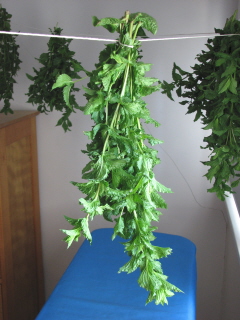 After a couple of false starts, I got the mint stringers suspended from picture hanger to hinge to picture hanger and directed the oscillating fan in their direction. I thought it best to keep air moving until all the water from washing had dried. (In retrospect, I think the fan was unnecessary, but all the instructions I read cautioned that herbs would mold if there wasn’t enough air. I should have known it wasn’t a big deal, though, considering one such instruction called 68 degrees F (20 degrees C) “warm.” That may be warm for winter, but it’s practically frigid in these parts in the summertime.)
(It’s dark in there when I close the shades, which I did. Please note the ironing board. It doesn’t get much use, but I do own one.)
Wait
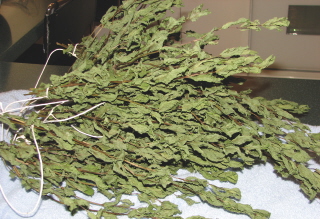
I waited. The mint withered and eventually became dry.
Second harvest
Eight days after I cut the mint, I took down the mint lines and stripped the leaves from the stems onto a clean kitchen towel.
Tip: Hold the tip of the stalk in one hand, and run your other hand down the stalk. The leaves will fall right off. If you go the other direction, trying to strip from the bottom up, you mostly flatten leaves. Whichever way you go, you’ll still have to pull the top leaves off one or two at a time.
Packing it in

The published advice encourages storing the leaves whole for greater retention of the oils that give the mint its flavor. Hence, I filled two quart mason jars and another jar I had on hand (capacity about 3 cups) with leaves, having the best luck by using a large cooking spoon for the transfer. I attached lids, and stuck the jars in a dark cabinet to wait until 68 degrees sounds warm to me. At that time, I intend to delight in brewing my own, organic free mint tea. (If you’re using this post as directions, you might want to check your jars for steam or any similar sign of moisture after the jars are closed an hour or two. I didn’t, because those leaves were crisp.)
Third harvest?
I have every reason to believe I’ll be able to cut and dry mint again before the season is over. I figure I’ve already dried enough to last me through the winter and then some. That gives me time to figure out whether any of my friends or family would be delighted with a gift of mint tea. You’ve been warned.
Meryl // Jul 7, 2008 at 3:08 pm
Your mint looks pretty hanging in your bedroom-bet it smelled great. I think you might have inspired me to dry some mint also. Wonder if I can use it in December mojitos?
Janet Majure // Jul 7, 2008 at 3:34 pm
It did smell great! I say go for it. I’ll bet dried-mint mojitos taste lovely, even if not quite as pretty as their fresh-mint siblings.
Steve and Seánan // Jul 8, 2008 at 7:01 am
There’s something wonderful about hanging herbs to dry. It isn’t only the immediacy of the experience or the anticipation of enjoying the dried herbs. It provides continuity. Herbs have been hung so for generations, in many eras and countries. All going well, herbs will be hung so for generations to come.
Thank you for both the instructions and the images.
Janet Majure // Jul 8, 2008 at 5:32 pm
And thank you Steve and Seanan!
Joanne // Jul 10, 2008 at 7:49 am
I love drying herbs! You’ve got a lot there-enough for tabbuleh, fatoush, and flavoring stuffed grape leaves right along with your mint tea and mojitos. Enjoy!
(I hear more scientists are off today to do field research and pick blackberries. I am overrun with blackberries!)
Preserving apples, part 1: getting saucy | foodperson.com // Jul 28, 2008 at 8:57 am
[…] finally got around to those apples, and my second adventure in food preservation for the year. (The dried mint was the first.) Seeing as I prefer to do things the hard way, I decided to turn some of the apples […]
Herb harvest signals beginning of season’s end | foodperson.com // Sep 22, 2008 at 8:37 am
[…] autumnal equinox, I went out yesterday and harvested herbs for drying. Based on my success with mint, I decided to cut and dry sage, rosemary (which had developed a couple of flowers), oregano and a […]
Kari Bell // Oct 22, 2008 at 5:45 am
We received a large bag of mint from a friend and although I put it in the fridge right away, I do know I need to get it hung. Is it ok in the refridgerator for a day or two?
I am sure it will lose some of it’s potency, but with 4 kids, I rarely have time to get to things like this until the weekend.
I loved all your information on mint by the way! Fantastic site!
Kari Bell
Janet Majure // Oct 22, 2008 at 7:51 am
Hi, Kari. Thanks for stopping by. Although I’m sure you’re right about the mint losing a little potency, I would think your mint would be fine to dry after a day or two. Sticking it in a glass of water till you can hang it also might work well, but mint tolerates cool temps very well, so the refrigerator treatment shouldn’t hurt it. Let me know how it turns out!
Sheri Wands // Jul 27, 2009 at 1:39 pm
I live in Tucson Az, and have mint,basil,and rosemary growing in my backyard, I want to dry mint and basil. Wasn’t sure best time of day to harvest, it’s very hot here, does it matter when I cut?
Janet Majure // Jul 27, 2009 at 2:28 pm
Hi, Sheri. I hear that it’s best to do it in the morning as soon as the dew is dry, but I’ve learned the plants are more forgiving than humans! In fact, in Tucson, you could probably just spread the cuttings out on a sheet and never mind about hanging them. They’ll dry in a few days.
kyndale // Aug 15, 2009 at 2:42 pm
I’m going to try this! Thanks for the great tutorial. :)Kyndale
Janet Majure // Aug 19, 2009 at 9:29 pm
Let me know how it turns out, Kyndale! And btw, I’ve since learned that it’s entirely possible to do it without such a big production. If you have a smaller quantity, you can just spread the cuttings out on a clean sheet or towel in an airy place until it’s good and dry.
mary // Sep 22, 2009 at 10:09 am
I will try this way of drying mint. I tryed a drying method in the oven that did not work.
After spending 4 hour removing all the leave and placing them in single layers and baking them for 12 hours they still are not dry
karlie // Jul 22, 2012 at 9:27 pm
I have read (somewhere…? All the links blur together when one is digging around the net for knowledge) that it is best to leave the oven door open a crack to let moisture escape. (also need oven barely on, only 170-180 degrees fahrenheit, which is the setting “warm” on most ovens). Maybe with next batch try keeping the oven door open a smidge, if you did not do so last time. I hang most of my herbs, but like a reader listed above I’m also a mom and sometimes oven drying is super appealing and easy. I’ve had tremendous luck with both! Drying my hoarde of mint for the second time this year and so far have produced over 10 mason jars of dried mint. I make dryer balls (put dried mint into panty hose legs, sew ends), put the same “dryer balls” only using satchels for the dresser to kep clothes smelling nice and minty, my own tea, infusions into vinegar for cleaning, infusions for my own handmade soaps shampoos and conditioner… mint is such a pleasing smell that everything I make, I make a surplus to give away to family and friends. Also, mint is great for the garden to keep pests away, and planted by the door it helps to keep mosquitoes and flys out. It’s such an amazing plant! Great instructions and great site, thanks!
Janet Majure // Sep 22, 2009 at 12:33 pm
Good luck, Mary. Patience, air and warm temps are all it takes-although low humidity certainly helps.
So you never said how the tea turned out. I’m in the process of drying my own mint and just found your site/post. I haven’t tried the tea yet and I’m just a bit nervous, because my attempts at chamomile tea were HORRENDOUS! Bitter. yech. Still not sure why that was the case and am curious if you tried yours and how it was.
Janet Majure // Oct 23, 2009 at 9:39 pm
Hi, Jennie. Thanks for stopping by. Haven’t tried chamomile, but my mint tea tasted like…mint tea. It was fine, and I used up all that I saved for me. Could bitterness be a matter of harvest time? Supposedly the ideal time is just before flowering. In any case, good luck if you give it another try!
M Jensen // Aug 15, 2010 at 4:53 am
I find your tutorial the best on the net. I also enjoy the step by step process you involves us all in, including the pictures. Very much appreciated from this end. I will try in today as my mint has begun to blossom and I have cut (sorry) the flowers. I heard on a tv program it was ok to do. Once I harvest some then I will stop cutting the flowers.
Janet Majure // Aug 15, 2010 at 8:00 pm
What a compliment, M! Hope your drying goes well for you and your mint.
M Jensen // Jul 11, 2012 at 3:03 pm
Hej Janet,
I want to let you know that it was a success and I have loved my fresh mint tea. :D Never store bought mint tea again!
Do you have any ideas for Lavender, we just moved into a house that has ton of lavender… I can’t wait to google about it.
All the best,
MJ
Janet Majure // Jul 13, 2012 at 9:45 am
Thanks for the update! As for lavender, you can use it in tea too (although I prefer it in a mixture of available herbs). You can get a good overview and links to recipes at http://whatscookingamerica.net/Lavender.htm (in case it didn’t show up in your Googling). Have fun!
Diane R // Aug 27, 2010 at 8:44 am
I searching for a website on how to make & dry mint tea. Your site came up first in Google. I recently moved into a new home & discovered on one side of my home that I have mint growing! I haven’t had mint tea since I was a child in PA Dutch country. I can’t wait to try making some again & dry my excess harvest. I want to try this drying process. The gift idea is a wonderful bonus for my family & friends. Thanks for sharing!!
Meg // Oct 13, 2010 at 3:52 pm
I love the way you write! It’s like listening to a neighbor tell stories about her garden. I am in my first year of growing about four different kinds of mints (just because I’ve always wanted to do that once I got my own house). I like what the poster said about there being continuity in drying herbs as well. Thank you so much for the great tips!
Janet Majure // Oct 28, 2010 at 8:25 pm
Glad to help. And thank you for your great comment!
Denise Claggett // May 11, 2011 at 12:24 pm
for the past several years we’ve made mint tea throughout the growing season. The mint patch is finally big enough to support our summer tea habit and provide a little extra for the colder months. How much dried mint do is needed for a pot of tea?
or, by the cup?
Janet Majure // May 11, 2011 at 1:46 pm
Hi, Denise,
Too many variables: How big is a cup? A pot? Fresh or dry mint? Your taste preferences?
Thus, my best answer is to experiment until you get it the way you like it. The good news is, that shouldn’t be a big burden! Happy tea-drinking. — Janet
Denise Claggett // May 11, 2011 at 3:15 pm
I figured you’d say that! A couple fresh hand full makes a nice gallon of iced tea……I’ll stick with that for now and begin our dried leaves experiment when it gets chilly again! Thanks for your postings!
Chris // Jul 13, 2011 at 10:07 pm
What kind of mint was it… Was it spearmint it looked like it?
Janet Majure // Jul 14, 2011 at 12:40 pm
Not sure, Chris. It was a start from someone else who didn’t know what it is. The taste certainly leans toward spearmint, though.
I’m back at Foodperson, come on in | foodperson.com // Jul 29, 2011 at 10:50 am
[…] How to dry mint (and other herbs) […]
Cindy R // May 2, 2012 at 1:52 pm
Thanks for the information on drying mint. I have a “large” over growing patch that I needed help with trying to figure out what to do with it. Once the leaves are dried do you think I could put them in a food saver bag and suck the air out to preserve them?
Janet Majure // May 3, 2012 at 9:07 pm
Hi, Cindy,
Glad the info was helpful. I don’t see any reason you couldn’t put the dried leaves in a food saver bag, but I’m not sure whether it would be of any benefit, either. The drying is a preservation technique in itself. I guess I’d check with local extension office on that question. Good luck! — Janet
Elizabeth // May 20, 2012 at 9:53 pm
I assume this would be identical for spearmint leaves?? I prefer these to peppermint and was thinking of planting them to harvest for tea…it’s my favorite!! This would sure save some money down the road when the plants are old enough. Thoughts?? : )
Janet Majure // May 21, 2012 at 10:18 am
Hi, Elizabeth. Yes, the process would be the same. In fact, I don’t know what kind of mint I have, but the scent and flavor are closer to spearmint that to peppermint. The process, in fact, is the same for pretty much any herb. Good luck!
Connie // Jun 16, 2012 at 2:55 pm
Hi Janet, great article. I have seen bags of Mint Leaves in a Grocery Store and I wondered, do I just spread them out to dry? The leaves are loose and there is no way to bundle them to hang them up. What would be the best way to go about? Thank you for any help you can give me. I love peppermint tea and up until now my parents always sent me some, I was excited to see the fresh leaves in the store.
Janet Majure // Jun 16, 2012 at 3:53 pm
Hi, Connie,
You certainly can spread them out to dry. The main things are to keep them out of sunlight and to make sure air circulates so that they do not mold. How much trouble to go to depends on how humid it is and how many leaves you are talking about. If it’s pretty humid, it’s not a bad idea to distribute them on a screen that you can suspend over sawhorses or such. Otherwise, just place them on a towel and let them dry. You can stir them occasionally if needed to promote even drying. I’m sure you will do fine. — Janet
Marie Powers // Jul 8, 2012 at 3:34 pm
I have had great luck drying herbs using my car as a dehydrator. I put the herbs on cookie sheets or disposable aluminum baking containers…put them in my car and crack a window just a bit. I park the car in the sun turn the herbs a few times a day. The herbs stay bright green and dry in two or three days depending on the weather.
Janet Majure // Jul 11, 2012 at 8:49 am
Aren’t you clever! I would have expected some loss of color, with the herbs out in the sun like that, so your idea is excellent for people in a hurry. Thanks, Marie.
Marie Powers // Jul 11, 2012 at 10:40 am
Thanks Janet. Actually the herbs are not in the sun to any great extent where I place the trays in the car. In addition the windows are slightly tinted so any sunlight they might get is filtered. I have tried all the other methods and the car greenhouse method is by far the best for me. I just finished drying spearmint and it turned out great.
Janet Majure // Jul 11, 2012 at 2:13 pm
Very cool! Or should I say warm? In any case, sounds as though you have worked it out. I’ll bet others will benefit from your ingenuity too. Thanks
Marie Powers // Jul 12, 2012 at 10:35 am
:)
tracey // Jul 17, 2012 at 10:33 am
can you still use the mint after they flower? mine flowered while on vacation.
Lorene Prenderville // Jul 19, 2012 at 11:46 am
My mint has also started to flower and I want to know should I mow it down and wait for it to grow again so I can harvest it? Or is it still usable with the flowers?
Janet Majure // Jul 19, 2012 at 12:39 pm
Tracey & Lorene:
You can still dry mint after it flowers, but I believe the oils that give mint its flavor may not be at their peak. Give it a try, and let us know how it does! — Janet
thomas // Jul 24, 2012 at 4:41 am
Hi all,
If you are like me and wanted to know some different drying methods - check this out:
http://voices.yahoo.com/how-dry-mint-tea-11577652.html?cat=32
Toni // Aug 10, 2012 at 10:41 am
Sorry, just a novice… wanted to know if you dry the flowers as well if the mint has already bloomed?
Toni // Aug 10, 2012 at 10:43 am
Thanks for the info, very helpfu. I was wondering if you dry the flowers as well if they’ve already bloomed?
Janet Majure // Aug 10, 2012 at 10:56 am
Hi, Toni. I don’t have any personal experience with doing so, but my understanding is that you can dry the flowers if you want and that they taste like the leaves, but milder. Give it a try! — Janet
Fern // Oct 24, 2012 at 7:09 pm
Question. How to keep the tea fragments from swimming around in the tea?
Deb // May 18, 2014 at 7:50 pm
I’m just getting started with herbs. I bought lemon mint and apple mint. Would it taste ok after I dry my harvest to blend these two together for tea? Any thoughts?
Janet Majure // May 28, 2014 at 10:17 am
Hi, Deb. I haven’t tried that particular combination, but I would think it should be great. Many people, in fact, believe that herb combinations are tastier than one-herb teas. I say go for it! If you are worried, though, you can see whether you like it by brewing up some tea using the fresh herbs. Or, you could dry the two separately, and then combine them or not when you make tea.
Miriam // Aug 4, 2014 at 11:53 pm
Hi Janet, lovee your article and my question is, what makes the leaves blacken while drying? I have alot of mint but turns black when I spread them on a cloth on my kitchen floors after couple weeks. What am I doing wrong? Any easy ideas rather than hang them? Thanks
Janet Majure // Aug 5, 2014 at 8:32 am
Hi, Miriam,
I don’t honestly know, but my guess would be that they aren’t drying fast enough and need more air circulation and/or warmer temps. If that’s the case, you could try laying the mint in a single layer on window screens or oven racks (to allow air to reach all sides) and/or running a fan on low in the room. If that doesn’t work or seems unworkable, you might try your county extension agent to see if she/he has any suggestions. You can locate yours here: http://www.csrees.usda.gov/Extension/